NBI Clearance vs Police Clearance
Learn the key differences between NBI Clearance and Police Clearance for jobs, travel, and legal requirements.
NBI Clearance vs Police Clearance: Which One Do You Need?
Many Filipinos get confused between NBI Clearance and Police Clearance because both are used for background checking. They may look similar in purpose, but they are not the same document. The main difference is the issuing agency and the scope of checking. NBI Clearance is issued by the National Bureau of Investigation, while Police Clearance is issued through the Philippine National Police system.
Quick Answer
NBI Clearance is usually needed for wider background checks, employment, overseas work, visa processing, and government-related requirements. Police Clearance is commonly used for local employment, local transactions, permits, and situations where a police record check is enough. If the employer, agency, or office specifically asks for NBI Clearance, you should not submit Police Clearance as a replacement. If they ask for Police Clearance, NBI Clearance may not always be accepted unless they allow an alternative document.
Simple rule:
What Is NBI Clearance?
NBI Clearance is a document issued by the National Bureau of Investigation. It checks whether the applicant has a criminal record, pending record, or possible name match in the NBI database. It is widely used in the Philippines for jobs, government transactions, travel abroad, visa requirements, and overseas employment. If there is a possible match, the applicant may receive a HIT status and wait for further verification.
NBI Clearance is commonly used for:
What Is Police Clearance?
Police Clearance is a document issued through the Philippine National Police system or authorized police offices. It verifies whether the applicant has a police record or derogatory record based on the police clearance system. The National Police Clearance System made the process more centralized than older local police clearance methods. Still, the receiving office decides whether Police Clearance is enough for the transaction.
Police Clearance is commonly used for:
Main Differences Between NBI Clearance and Police Clearance
The biggest difference is scope. NBI Clearance is usually treated as a broader national background check, while Police Clearance focuses on police records through the PNP clearance system. Another difference is use. NBI Clearance is more commonly requested for overseas work, visa, and higher-level background checks, while Police Clearance is often enough for local or city-level requirements.
|
Comparison |
NBI Clearance |
Police Clearance |
|---|---|---|
|
Issuing Agency |
National Bureau of Investigation (NBI) |
Philippine National Police (PNP) |
|
Common Use |
Jobs, visas, overseas employment, and government requirements |
Local jobs, permits, and local transactions |
|
Scope |
Checks records through the national investigation database |
Checks records through the police clearance system |
|
Possible Delay |
HIT status may delay release |
Usually faster if there are no issues |
|
Abroad Use |
More commonly requested for international purposes |
Less commonly accepted for overseas requirements |
|
Replacement |
Cannot always replace a Police Clearance |
Cannot replace an NBI Clearance when NBI is specifically required |
Requirements Comparison
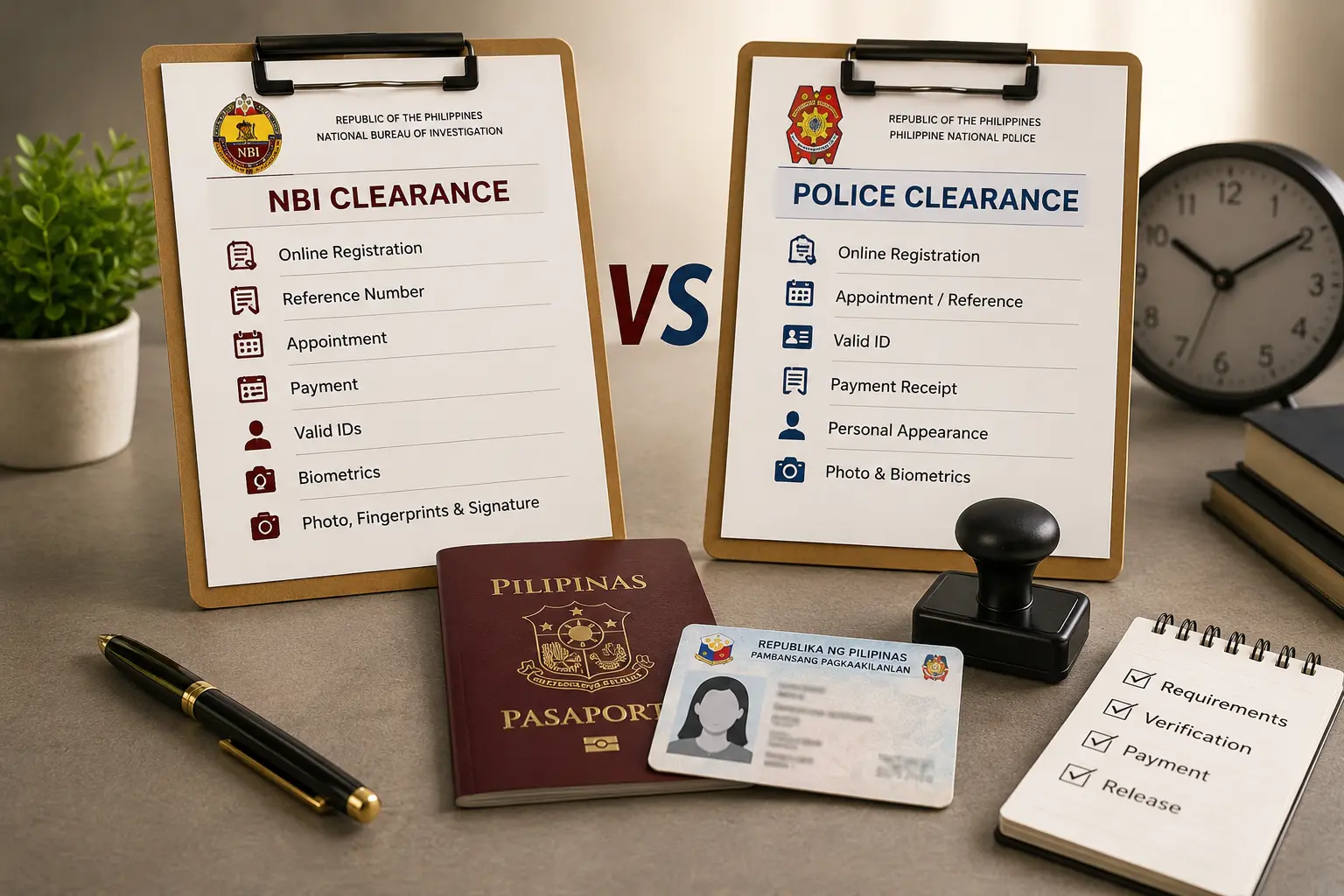
Both clearances require identity verification, but the exact requirements are different. NBI Clearance usually requires an online account, reference number, appointment, payment, and valid IDs. Police Clearance also uses online registration and police station appearance for verification. In both cases, your personal details should match your IDs to avoid delays.
NBI Clearance requirements may include
Police Clearance requirements may include:
Fees, Validity, and Processing Time
NBI Clearance and Police Clearance have different fees and processing rules. NBI Clearance fees may include the basic clearance fee plus convenience charges depending on the payment method. National Police Clearance also has its own fee and possible convenience charge. Always check the official portal before paying because charges and payment channels can change.
Processing can be fast when there are no issues. NBI Clearance may be released on the same day if there is no HIT, but a HIT can delay release. Police Clearance is often faster for many applicants, especially when the station has no queue and the transaction is already paid. Validity also depends on the printed expiry date and the rule of the office requesting the document.
Which One Is Better for Employment?
For local employment, the better document depends on what the employer asks for. Some companies accept Police Clearance because they only need a local or general police record check. Other companies require NBI Clearance because they want a broader background check. Government jobs, security-related roles, finance jobs, and overseas employment often have stricter requirements.
Use this guide:
f you’re applying for your first job, check out our complete NBI First Time Job Seeker guide to learn about eligibility, requirements, and how to claim your free NBI Clearance.
Which One Do You Need for
Abroad or Visa Use?
For overseas employment, visa, immigration, and embassy-related transactions, NBI Clearance is usually the more relevant document. Many foreign employers and visa offices ask for NBI Clearance because it is the better-known national clearance from the Philippines. Police Clearance may be useful locally, but it is not always accepted for international processing. If your checklist says NBI Clearance, do not replace it with Police Clearance unless the embassy or agency confirms it.
For abroad-related use, check:
If your NBI Clearance application shows a HIT status, read our detailed guide to understand what it means, why it happens, and what steps you should take next.
Police Blotter vs NBI Clearance
A police blotter is not the same as NBI Clearance. A police blotter is usually a record of an incident reported to the police, such as loss of ID, accident, complaint, theft, or dispute. NBI Clearance is a background check document used to show whether you have a record or possible record match. A blotter does not prove that you are cleared for employment or visa purposes.
Simple difference:
Common Mistakes to Avoid
Many applicants waste time because they submit the wrong clearance. This often happens when they think Police Clearance and NBI Clearance are the same. Another common mistake is applying for the cheaper or faster document without checking the requirement list. The safest move is to read the exact wording from the employer, school, agency, embassy, or government office.
Avoid these mistakes: